Report
DeepSeek V4
A research report on DeepSeek V4, released 2026-04-24.
Status — V4 is released. DeepSeek launched the V4 Preview on April 24, 2026, shipping two production-ready open-weights models — V4-Pro and V4-Flash — under the MIT license. This report is being built incrementally; see the changelog for what’s been added.
How to read this report
This page is the executive summary. Pick the path that matches what you came for:
- “What’s the takeaway in 5 minutes?” → The V4 thesis — six observations that will still matter about V4 a year from now.
- “Just tell me if I should use it.” → Benchmarks — V4-Pro-Max vs frontier and Limitations — what DeepSeek themselves call out.
- “How do I call the API?” → API — Quick start. One curl, then JSON mode and tool use further down the page.
- “I’m already on V3 — should I move?” → V3 → V4 Migration Guide. One-line code change, July 24 retirement deadline, cost recalibration worksheet.
- “How does it actually work?” → Technical Details — architecture overview, then V3 → V3.2 → V4 diff.
- “What’s the catch?” → Limitations — training stability is held together by techniques DeepSeek doesn’t fully understand is the most candid section in V4’s tech report.
- “How can I verify it for myself?” → Independent Testing — three reproducible prompts with a Python harness.
- “Should I run V4 on my own hardware?” → Self-hosting V4 — hardware budgets, serving frameworks, and when the API is the better answer.
- “What does CSA/HCA/mHC/OPD/etc. mean?” → Glossary — every acronym in the report, defined in one place.
- “What did this report get wrong?” → Errata — material corrections, dated and traceable.
Total reading time end-to-end: ~25 minutes. Each subpage is independently navigable.
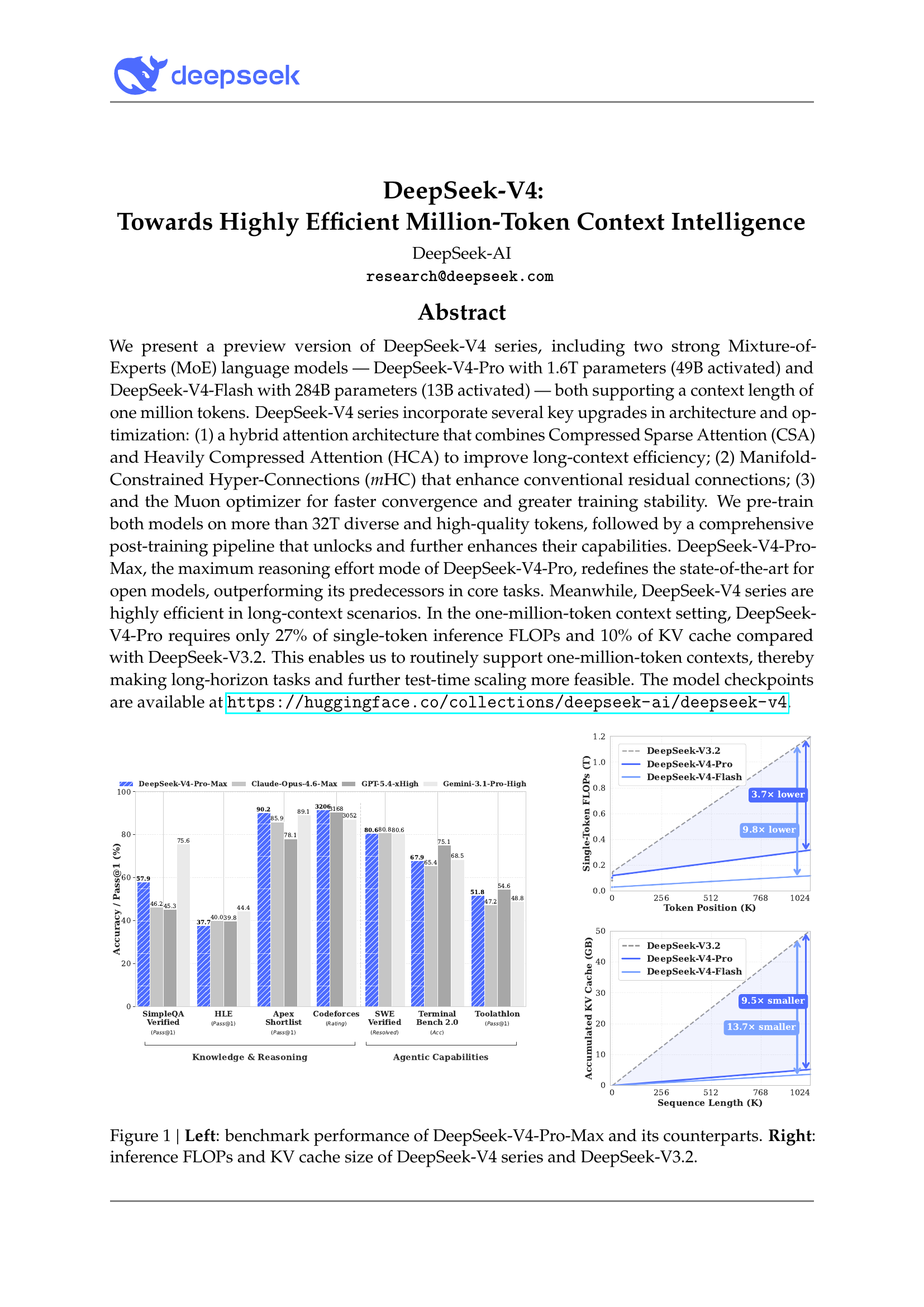 Cover page of
 DeepSeek_V4.pdf. The headline chart compares V4-Pro-Max to Claude Opus 4.6 Max, GPT-5.4 xHigh, and Gemini 3.1 Pro High; the right panels show V4’s FLOPs and KV-cache reductions vs V3.2 at 1M context.
 Official DeepSeek V4 specification card. Source: api-docs.deepseek.com.
At a glance
| DeepSeek V4-Pro | DeepSeek V4-Flash | |
|---|---|---|
| Total params | 1.6T | 284B |
| Active params | 49B | 13B |
| Context | 1M tokens | 1M tokens |
| Architecture | MoE + DeepSeek Sparse Attention (DSA) | MoE + DeepSeek Sparse Attention (DSA) |
| Modes | Thinking / Non-Thinking | Thinking / Non-Thinking |
| License | MIT (open weights) | MIT (open weights) |
| API model ID | deepseek-v4-pro |
deepseek-v4-flash |
| Input (cache-miss) | $1.74 / 1M tokens | $0.14 / 1M tokens |
| Input (cache-hit) | $0.145 / 1M tokens | $0.028 / 1M tokens |
| Output | $3.48 / 1M tokens | $0.28 / 1M tokens |
Sources: DeepSeek API Docs — V4 Preview Release · DeepSeek API Pricing
What’s new vs V3
- DeepSeek Sparse Attention (DSA) — token-wise compression that, in 1M-token settings, brings V4-Pro to roughly 27% of single-token inference FLOPs and 10% of the KV cache of V3.2.
- 1M context as the default across all official services.
- Two-tier lineup (Pro for frontier reasoning, Flash for cost-sensitive deployment).
- Hybrid Thinking / Non-Thinking modes in a single model — replacing the V3-era split between
deepseek-chatanddeepseek-reasoner. - Aggressive pricing — V4-Flash output at $0.28 / 1M tokens is roughly an order of magnitude below frontier closed models.
Site map
Thirteen pages, grouped by intended use. The sidebar mirrors this grouping.
Read first
- The V4 thesis — six observations that will still matter about V4 a year from now. Curatorial editorial summary.
- API documentation — endpoints, auth, JSON mode, function calling, cost calculator, cross-vendor pricing, alternative providers, “Choosing V4-Pro vs V4-Flash” decision flow with concrete app patterns.
- V3 → V4 migration — one-line code change, July 24 retirement deadline, cost recalibration with explicit ratios.
Detail
- News & timeline — release timeline, official announcement quotes, press coverage, community reception (Hacker News + Simon Willison + community quants), industry reactions, geopolitical / IP controversy.
- Technical details — config-backed architecture (CSA + HCA, mHC, MoE expert counts), V3 → V3.2 → V4 diff, training pipeline, training-stability candor, FP4/FP8 quantisation, architecture-decisions journal.
- Benchmarks — official Tables 1, 6, and 7 verbatim, formal-reasoning Putnam regimes, MRCR long-context curve, reasoning-effort scaling, win-rate analysis vs Opus.
- Self-hosting — hardware budgets per variant, serving framework matrix (NIM / SGLang / vLLM / GGUF / MLX), real-world throughput numbers, when the API is the better answer.
- Independent testing — three reproducible test prompts with a Python harness (coding, reasoning, 750K-token needle).
- Limitations & safety — DeepSeek’s own Section 6 candor, V3-era red-team findings that likely extrapolate, content-filtering on the hosted API.
Reference
- References — full bibliography with access dates.
- Glossary — ~25 acronyms (CSA, HCA, DSA, MLA, mHC, MoE, OPD, GRPO, YaRN, etc.) defined in one place.
- Errata — material corrections to past claims, dated and traceable.
Cross-site:
- Changelog — dated log of every iteration’s contribution.
Migration note
DeepSeek’s existing deepseek-chat and deepseek-reasoner endpoints currently route to V4-Flash in Non-Thinking and Thinking modes respectively. Both will be fully retired after 2026-07-24, 15:59 UTC. New code should target deepseek-v4-pro or deepseek-v4-flash directly.
Source: DeepSeek API Docs — V4 Preview Release.
Citing this report
This is a living document. If you reference a specific claim, link to the section anchor and note the access date — the page may have been re-verified or corrected since.
Suggested citation format:
1011-a. (2026). DeepSeek V4 — research report. Reports.
Retrieved <ACCESS_DATE> from https://1011-a.github.io/reports/deepseek-v4/
BibTeX:
@misc{1011a_deepseekv4_2026,
  author       = ,
  title        = {DeepSeek V4 --- research report},
  howpublished = {Reports},
  year         = {2026},
  url          = {https://1011-a.github.io/reports/deepseek-v4/},
  note         = {Accessed: <ACCESS_DATE>}
}
For specific subpages, append the subpage path (e.g., /deepseek-v4/benchmarks/) to the URL. Every long page has a “Last verified” date stamp under its TL;DR — that’s the most accurate reference point for when its claims were last reconciled with primary sources.
If you spot something materially wrong, the Errata page documents prior corrections; new errata can be opened as issues at github.com/1011-a/reports.
The full source of this report — markdown, configs, and rendered figures — lives at the same GitHub URL under MIT-equivalent terms (the report cites primary sources whose own licenses apply to their content).